Every Sunday night, a small voice in my head asks the same question: “What exactly is happening this week?” For years, my answer was a confident shrug.
The fix turned out to be boringly simple: a weekly review. Twenty minutes, once a week, and you stop being surprised by your own calendar. No fancy app required, no color-coded masterpiece, and no guilt about the three things you didn’t finish last week (we’ll deal with those, too).
Here’s the exact process, step by step, so you can run your first weekly review today.
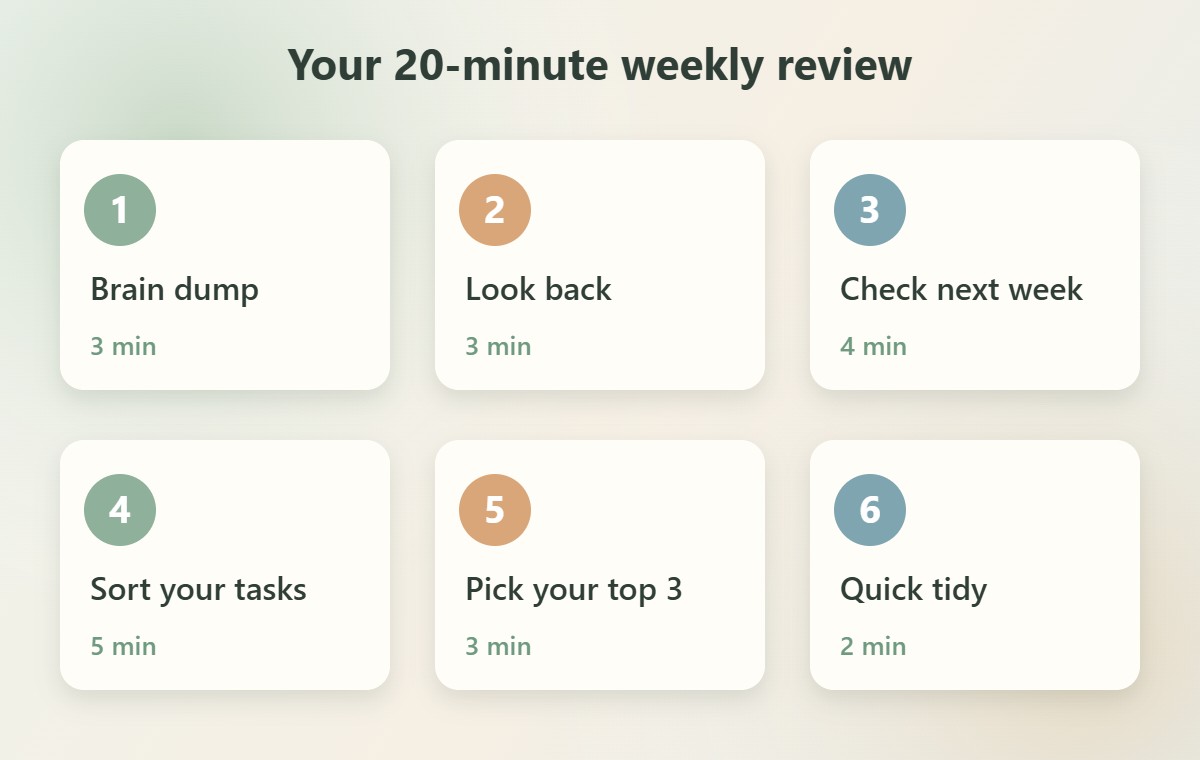
In a hurry? The whole review in six lines:
- Brain dump everything (3 min)
- Look back at last week (3 min)
- Check next week’s calendar (4 min)
- Sort your tasks (5 min)
- Pick your top three (3 min)
- Quick tidy (2 min)
What is a weekly review (and why bother)?
A weekly review is a short, regular check-in where you look back at the week that just ended, clear out the clutter, and decide what matters in the week ahead. Think of it as a tidy-up for your head rather than your house.
The payoff is bigger than the twenty minutes suggests:
- You catch things before they become emergencies (hello, expired passport and surprise school forms).
- You stop carrying a mental to-do list that never switches off.
- Your week starts with a plan instead of a scramble.
- Nothing important lives only in your memory, which is a notoriously unreliable filing system.
What you’ll need
- Your calendar (paper or digital, whichever you actually look at)
- Your to-do list or task app
- A notebook or a sheet of paper for loose thoughts
- A drink of your choice and a spot where nobody will ask where the scissors are
Personally, I always do my weekly review first thing on Sunday morning, when I’m at least halfway through my first cup of coffee. By then, my head is a bit clearer, which helps when I’m trying to do some much-needed planning.
The 20-minute weekly review, step by step
Step 1: Brain dump (3 minutes)
Write down everything that’s rattling around in your head: tasks, worries, half-ideas, that email you keep meaning to answer. Don’t organize it. Don’t judge it. Just get it out of your head and onto the page.
Step 2: Look back at last week (3 minutes)
Glance at last week’s calendar and task list. What got done? What didn’t? Skip the self-criticism. You’re gathering information, not holding a trial. If something got carried over three weeks in a row, it’s either not important or it’s secretly too big. Either way, it needs attention in step 4.
Step 3: Check the week ahead (4 minutes)
Open next week’s calendar and read through every day. Look for appointments, deadlines, birthdays and anything that needs preparing. Add anything from your brain dump that has a date attached. This is where you catch the “oh, that’s on Thursday?” moments before Thursday.
Step 4: Sort your tasks (5 minutes)
Go through your task list and your brain dump. For each item, pick one:
- Do it this week: give it a day.
- Do it later: park it on a “someday” list.
- Drop it: if it’s been stuck for ages and nothing bad has happened, it’s probably allowed to go.
- Break it down: if it keeps getting skipped, it’s too vague. “Sort out taxes” becomes “find last year’s return.”
Step 5: Pick your top three (3 minutes)
Choose the three things that would make this week feel like a success. Just three. Everything else is a bonus. Put them somewhere you’ll see them every day, on a sticky note, at the top of your planner, or as the first items in your app.
Tip: three is the magic number. If your top-three list quietly grows to eight, it isn’t a top-three list any more. It’s a to-do list wearing a party hat.
Step 6: Do a quick tidy (2 minutes)
Close the extra browser tabs, clear your desk of the week’s clutter, and put anything stray (receipts, forms, mystery paper) in one tray for later. You’re not cleaning the whole house, just resetting your workspace.
Make it stick
- Pick a fixed time. Sunday evening and Friday afternoon both work well. Habits like a regular slot.
- Keep it short. If it creeps past 30 minutes, you’re doing too much. Trim the steps.
- Use what you already have. A fancy new planner is not a prerequisite. A plain notebook works fine.
- Make it pleasant. Good coffee, a favourite playlist, a comfy chair. If it feels like a punishment, you’ll skip it.
Common questions
What if I miss a week?
Then you do it next week. Nobody is grading you. Skipping a review doesn’t undo the habit, but giving up after one miss does.
Should I use a paper planner or an app?
Whichever one you’ll actually open. Both work. I’ll go into the pros and cons in a future post.
Is 20 minutes realistic?
For most people, yes, once you’ve done it a couple of times. The first one may take longer, and that’s fine.
The bottom line
A weekly review won’t make your life perfectly tidy, and I’m not promising it will. But it makes the week ahead feel manageable instead of mysterious, and that’s a pretty good return on twenty minutes. Try it this week, and see how Monday feels.
Coming soon: a free one-page weekly review checklist you can print. For now, copy the six steps above onto a sticky note and you’re ready to go.
Save this for later
Pin it to your planning board so it’s there when Sunday rolls around.